
Author(s): Saha J, Gaba A, Singh OG, Ch Marak AC
Cite this article as: Saha J, Gaba A, Singh OG, Ch Marak AC. Investigative Interface Of Psychological Autopsy In Forensic Psychology: Enhancing Criminal Investigation And Justice Delivery. Int J Health Res Medico Leg Prae. 2026 Jan-June;12(1):29-36.
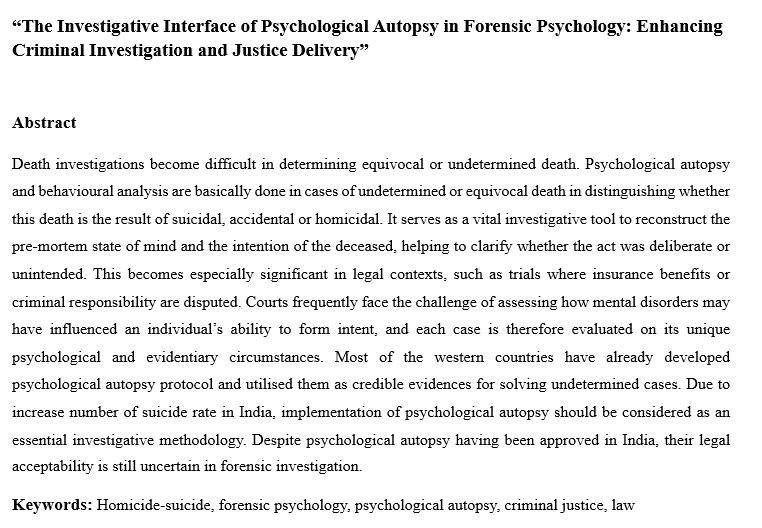
Death investigations become difficult in determining equivocal or undetermined death. Psychological autopsy and behavioural analysis are basically done in cases of undetermined or equivocal death in distinguishing whether this death is the result of suicidal, accidental or homicidal. It serves as a vital investigative tool to reconstruct the pre-mortem state of mind and the intention of the deceased, helping to clarify whether the act was deliberate or unintended. This becomes especially significant in legal contexts, such as trials where insurance benefits or criminal responsibility are disputed. Courts frequently face the challenge of assessing how mental disorders may have influenced an individual’s ability to form intent, and each case is therefore evaluated on its unique psychological and evidentiary circumstances. Most of the western countries have already developed psychological autopsy protocol and utilised them as credible evidences for solving undetermined cases. Due to increase number of suicide rate in India, implementation of psychological autopsy should be considered as an essential investigative methodology. Despite psychological autopsy having been approved in India, their legal acceptability is still uncertain in forensic investigation.

Jayashri Saha
Externs
Maulana Abul Kalam Azad University Of Technology, Kalyani, West Bengal
Article reads consist of online article views and PDF downloads.
Views
291
Downloads
24